

Investment Report – November 2026
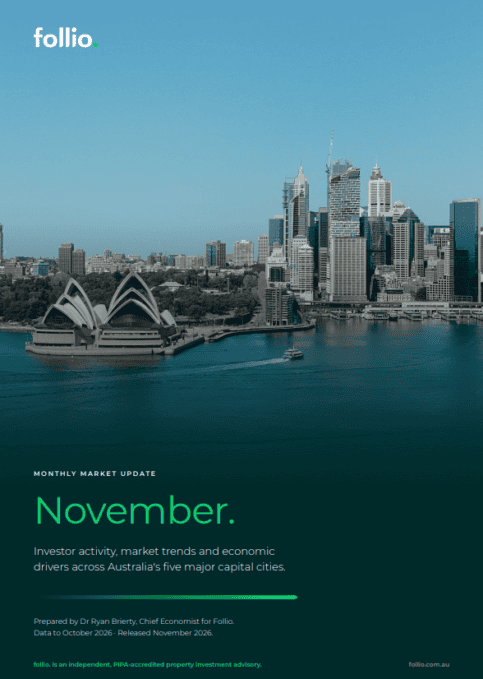
A downturn in housing values across Australia’s major capital cities (Perth, Melbourne, Sydney, Brisbane and Adelaide) has now been firmly established, driven by consecutive RBA interest rate rises, recent changes by the Government to tax policies and a continuously shifting housing and investment landscape.
Despite this, falling property prices are reshaping rental yields and market entry costs throughout the country. Discover the main takeaway from our November 2026 investment report below.
Australia’s Housing Downturn Is Now Firmly Established Across All Five Capitals
Annual growth has deteriorated once again across all five capital cities in October, with Sydney recording the largest annual decline (-9.4%) followed closely by Melbourne (-7.5%). Perth has fallen from 26% annual growth to just 3.9%, while Adelaide is down to 4% and Brisbane is down to 0.7%. Despite this, monthly declines eased in Brisbane, Adelaide and Perth.
Tight Rental Markets and Rising Gross Yields
Rental market conditions across the major capitals in Australia remain tight, although there are diverging trends emerging throughout different housing markets. Vacancy rates in September (the last month of data for vacancy rates) in Sydney and Melbourne both rose 1.8 and 1.9%, respectively. Whilst they held at 0.9% in Brisbane and at 0.6% in Perth and Adelaide.
Despite the tight vacancy rates, weekly rent remained stable in October due to tenant affordability constraints. As dwelling prices are falling while rents stay stable, gross rental yields increased in four of the five capitals in October Melbourne offers the highest yield at 4.6%, with Perth closely following at 4.48%.
Investor Loan Commitments Dropped in June Quarter
Investor loan commitments across every major state fell for the June quarter, with NSW seeing the biggest drop of 15.5%. Victoria had a large decrease of 14.2%. Despite a drop in loan commitments, the average investor loan size increased nationwide during the same period. These figures precede the upcoming release of September-quarter data, which will shed further light on how investors are responding to federal changes regarding negative gearing and the Capital Gains Tax (CGT) discount.
Australia’s Economic Backdrop Has Tightened Further, Heading Toward the End of the Year
Headline inflation continues to rise in Australia, with September at 4.3%, and trimmed-mean inflation increasing to 3.6%. Interest rates themselves continue to rise, with the RBA again increasing the cash rate for a fifth time this year by 25 basis points. These indicators bring Australia uncomfortably close to the “Three 5s” scenario: inflation, the cash rate, and unemployment all edge closer to 5 per cent. This creates a delicate balancing act for the RBA as it tries to tame persistent inflation without triggering a severe economic contraction.
Explore the Full November Investment Report
Want to dive deeper into the data, state-by-state breakdowns, and what these market conditions mean for your portfolio strategy? Download our November Investment Report by filling in our form.
Download The Investment Report
Our research
Decisions Back By Data
Access all our research reportsWhat we research

What we research
What we track

What we track
How and why we do it

How and why we do it
Build the portfolio
of tomorrow.
I am...