

Australian Housing Market Snapshot – October 2026
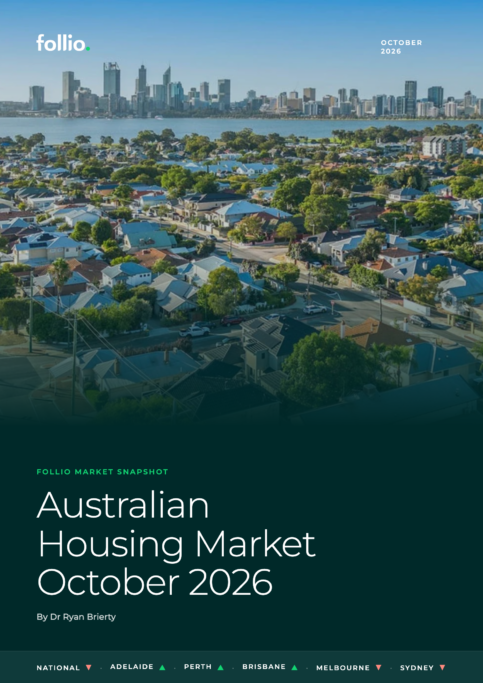
Welcome to the October edition of the Ryan Brierty Property Blog, which provides a snapshot of the national housing market and conditions across the five major capital cities.
Australian Housing Market Snapshot – September 2026
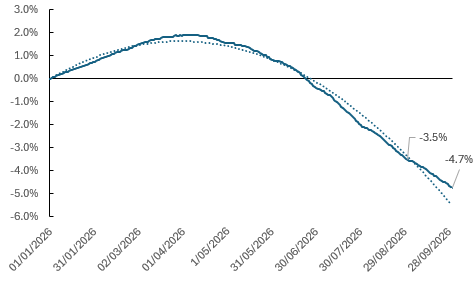
Australia’s housing market downturn continued during September, with national dwelling values falling throughout the month. At the end of August, national prices were approximately 3.5 per cent below their level at the beginning of the year. By the end of September, that decline had increased to 4.7 per cent, representing a further deterioration of around 1.2 percentage points in September alone.
The scale of the downturn becomes even clearer when measured from the market’s peak in early April. By the end of August, national dwelling values had fallen approximately 5.3 per cent from their peak. By the end of September, this decline had increased to approximately 6.5 per cent. The gains recorded during the opening months of 2026 have therefore been more than reversed, with national dwelling values now well below both their early-April peak and their level at the beginning of the year.
As shown in Figure 1, national dwelling prices continued to decline throughout September, reaching 4.7 per cent below their level at the beginning of the year. However, an important change emerged during the month. The actual price series moved above the fitted 2026 trajectory, indicating that while dwelling prices continued to fall, the rate of decline had begun to moderate. This is broadly consistent with conditions in most major capital cities, where the pace of price declines has recently stabilised or eased.
This divergence between actual prices and the fitted trend will be important to monitor over the coming months. The current moderation does not indicate that dwelling prices have reached a bottom; rather, it suggests that prices are presently falling at a slower rate. With interest rates expected to rise further, the key question is whether renewed pressure on borrowing capacity, mortgage servicing costs and buyer confidence causes the rate of dwelling price decline to accelerate again.
Figure 1. National dwelling price growth, 2026.
What is Driving the Shift in the Property Market?
September brought a significant change in the economic environment confronting the housing market. Just as the rate of dwelling price decline began to show signs of moderating, renewed inflationary pressure led to another increase in interest rates. This has added to the borrowing capacity and affordability pressures already weighing on housing demand.
The latest inflation data reinforced the problem. Annual headline inflation increased from 3.5 per cent in July to 4.0 per cent in August, while trimmed mean inflation remained unchanged at 3.6 per cent. Both measures therefore remain above the Reserve Bank’s 2 to 3 per cent target range, reinforcing concerns that inflationary pressures remain persistent.
The Reserve Bank subsequently increased the cash rate by 25 basis points to 4.60 per cent at its September meeting. This represents an important development for the housing market. The additional tightening comes after dwelling prices have already fallen considerably from their April peak and will place further pressure on borrowing capacity and mortgage servicing costs.
The full effect of the September rate increase will take time to flow through to housing demand. This makes the recent moderation in the rate of decline in dwelling prices particularly important. The key question over the coming months is whether that moderation can continue or whether tighter monetary conditions cause the housing downturn to accelerate again.
Capital City Property Market Snapshot
- Adelaide is now the strongest-performing of the five major capital cities on a year-to-date basis, with dwelling values remaining approximately 2.0 per cent above their level at the beginning of 2026. However, this position masks a significant deterioration in current conditions. Growth has fallen from a peak of 5.1 per cent in June, while the estimated dwelling value declined by more than $12,000 during September to approximately $918,000. More importantly, Adelaide was the only major capital city in which the rate of price decline accelerated in September, suggesting its downturn is continuing to gain momentum.
- Perth is now the second strongest-performing capital city on a year-to-date basis, with dwelling values remaining approximately 1.6 per cent above their level at the beginning of 2026. This is nevertheless well below the peak year-to-date growth of 7.8 per cent recorded in May, with the estimated dwelling value having fallen from just over $1.01 million to approximately $956,000. Unlike Adelaide, however, the rate of price decline moderated during September, providing some evidence that the pace of Perth’s downturn has begun to ease.
- Brisbane’s housing market continued to weaken during September. Year-to-date growth has fallen from 5.5 per cent in May to just 0.3 per cent by the end of September, while the estimated dwelling value declined by nearly $15,000 during the month to approximately $1.036 million. However, as in Perth, the rate of decline moderated during September, suggesting that while Brisbane’s downturn remains firmly established, its pace has recently eased.
- Melbourne’s housing market was virtually flat during September, despite dwelling values remaining approximately 7.2 per cent below their level at the beginning of the year. The estimated dwelling value declined by only around $500 during the month to approximately $774,000, leaving values almost $58,000 lower than at the beginning of the year. This represents a significant moderation in the rate of decline, although it remains too early to conclude that Melbourne’s housing market has reached a bottom.
- Sydney remains Australia’s weakest-performing capital city on a year-to-date basis, with dwelling values approximately 8.3 per cent below their starting level by the end of September. The estimated dwelling value declined by approximately $17,000 during the month to just under $1.175 million, leaving values more than $102,000 lower than at the beginning of the year. However, the rate of decline also moderated during September, suggesting that the pace of Sydney’s downturn has eased even though dwelling prices continue to fall.
What This Means for the Australian Property Market
Australia’s housing downturn deepened further during September, with national dwelling values now 4.7 per cent below their level at the beginning of the year and approximately 6.5 per cent below their April peak. All five major capital cities are now experiencing declining dwelling prices, meaning the distinction between the markets remains primarily one of timing and magnitude rather than direction.
However, an important change emerged during September. Although dwelling prices continued to fall, the rate of decline moderated across most of the major capital cities, with Adelaide the notable exception. This is also evident in the national results, where actual dwelling prices exceeded the fitted 2026 trajectory during September. This does not suggest that the housing downturn is over, but it does indicate that the pace of deterioration eased compared with the sharper declines recorded during July and August. Importantly, this moderation occurred before the effects of the September interest rate increase could be reflected in housing market conditions. With borrowing costs having risen again and the possibility of further rate increases still in place, the recent moderation could prove temporary if tighter financial conditions further weaken housing demand.
The downturn continues to reinforce the importance of demand-side conditions. Housing supply constraints and population growth may provide structural support in some markets, but they have not been sufficient to prevent prices from falling as borrowing capacity, affordability, and buyer confidence have weakened. Further monetary tightening would intensify these pressures by reducing borrowing capacity and increasing mortgage servicing costs. The experience of 2026, therefore, demonstrates that constrained housing supply alone cannot sustain price growth when effective housing demand is deteriorating.
Market Outlook
The key question has now shifted from whether the rate of dwelling price decline will begin to moderate to whether that moderation can be sustained. Prices remain well below their April peak, and there is still insufficient evidence to conclude that Australia’s housing market is approaching a bottom. Nevertheless, the slower rate of decline across most capital cities during September represents an important change from the acceleration evident during July and August.
Interest rates will be critical in determining what happens next. The September increase in the cash rate will take time to flow through to borrowing capacity, mortgage servicing costs and buyer confidence, while the possibility of further rate increases presents an additional risk to housing demand. If monetary policy tightens further, the moderation observed during September may prove temporary, and the rate of dwelling price decline could begin to accelerate again.
The coming months will therefore provide an important test for Australia’s housing market. A continued moderation in the rate of decline would suggest that the downturn is beginning to stabilise, even if dwelling prices continue to fall. Conversely, renewed acceleration as higher interest rates flow through to housing demand would indicate that the downturn has entered another, potentially more pronounced, phase. For now, prices are still falling, but whether the recent moderation can survive a period of tighter monetary policy has become the key indicator to watch.
Disclaimer: This publication is intended to provide general information only. It does not take into account the specific objectives, financial situation or needs of any particular person. You should consider the appropriateness of this information in relation to your personal circumstances before making any investment decision. While every effort is made to ensure the accuracy of the information provided, no warranty is given as to its correctness, completeness, or reliability.
Our research
Decisions Back By Data
Access all our research reportsWhat we research

What we research
What we track

What we track
How and why we do it

How and why we do it
Build the portfolio
of tomorrow.
I am...